
Across the United States, colleges and universities are confronting a rising wave of sophisticated criminal schemes that exploit enrollment and financial aid systems. These schemes commonly involve so-called “ghost students”—fraudulent or fabricated identities that enroll, trigger financial aid disbursements, and then vanish. This issue has escalated from a minor nuisance to a multi-million-dollar crisis, siphoning away resources intended for legitimate students and eroding the integrity of higher education.
While initial ghost student fraud focused on new applicants, a more insidious evolution has emerged: re-admit fraud. This variant of the scam exploits the very systems designed to support returning learners, creating a revolving door for financial aid abuse. As institutions grapple with this threat, it is imperative for administrators, enrollment officers, and CFOs to understand the scale of the problem and adopt robust, proactive strategies to defend against it.
The Escalating Scale of Enrollment Fraud
The financial and operational impact of ghost student fraud has surged dramatically in recent years. What was once considered a sporadic issue has become a systematic assault on institutional resources. The rapid shift to online learning during the COVID-19 pandemic, coupled with nearly $40 billion in federal stimulus for emergency student aid, created a perfect storm for fraudsters. Legacy systems, often reliant on manual checks, were ill-equipped to handle the volume and sophistication of modern fraud tactics, leading to staggering losses.
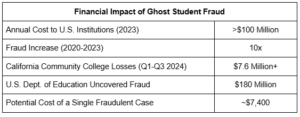
Recent data paints a stark picture of the crisis:
Over the past five years, financial aid fraud in higher education has surged dramatically, costing institutions across the United States upward of $100 million per year as of 2023—compared to less than $10 million annually reported before 2020.
This tenfold increase highlights the escalating nature of the threat. The problem is particularly acute in the community college sector, where open enrollment policies create a wider entry point for bad actors. In California alone, community colleges disbursed more than $7.6 million in aid to fraudulent identities in the first three quarters of 2024, a significant increase from $4.4 million for the entirety of 2023.
Some estimates suggest that as many as one in four applicants to the state’s community college system is fraudulent.
The U.S. Department of Education has uncovered a $180 million problem for the nation’s community colleges, which includes $150 million in aid to ineligible students and $30 million paid to applicants using the stolen identities of deceased individuals.
These are not isolated incidents but coordinated attacks by sophisticated criminal networks that leverage bots, synthetic identities, and stolen data to overwhelm institutional defenses.
This rampant fraud has consequences that extend far beyond direct financial losses. It creates significant operational burdens, erodes trust among donors and stakeholders, and, most importantly, denies educational opportunities to deserving students. As institutions face the dual pressures of declining enrollment and heightened financial scrutiny, addressing this challenge has become a strategic imperative.
The Next Evolution: Weaponizing Stolen Data for Re-Admit Fraud
While traditional ghost student fraud uses fabricated or synthetic identities, a far more sinister evolution has emerged, directly targeting innocent individuals and weaponizing their academic history. This advanced scheme, a specific and devastating form of re-admit fraud, is fueled by large-scale data breaches, such as the one impacting the National Student Clearinghouse. The primary victims are no longer just institutional budgets, but the real former students whose identities are stolen.
Here is how this sophisticated attack unfolds:
-
Data Acquisition: Fraudsters acquire the personal data of real former students from breaches like the National Student Clearinghouse. This gives them legitimate names, Social Security Numbers, and dates of birth tied to a specific institution.
-
Impersonation via a New Application: The fraudster submits a new application to the institution using the stolen identity of the former student.
-
Automated System Exploitation: The institution’s Student Information System (SIS) automatically recognizes the core data (SSN, DOB) and, assuming it is a legitimate returning student, flags the application as a “re-admit.” This often triggers a less stringent verification process and may even merge the fraudulent application with the legitimate student’s historical record.
-
Financial Aid and Private Loan Fraud: Once “re-admitted,” the imposter registers for classes and applies for federal financial aid and, critically, private student loans in the real student’s name.
-
The Devastating Aftermath: The fraudster collects the aid and loan disbursements and vanishes. The real former student, who may have graduated years ago, is now saddled with thousands of dollars in fraudulent debt, a damaged credit score, and the nightmare of dealing with collection agencies for loans they never took out.
This form of re-admit fraud is not just an attack on an institution’s financial aid system; it is a targeted act of identity theft that can cause long-term financial and emotional ruin for its victims. It exploits the trust inherent in re-enrollment processes and turns an institution’s own data and automated workflows into a weapon against its former students.
A Proactive Framework for Institutional Defense
To combat the multifaceted threat of ghost students and re-admit fraud, institutions must move beyond reactive measures and adopt a proactive, multi-layered defense. This requires a strategic framework that integrates advanced technology, cross-functional collaboration, and robust policies. The goal is not to create barriers for legitimate students but to build a smarter, more resilient enrollment ecosystem.
Based on best practices from cybersecurity, finance, and higher education, a comprehensive defense strategy should be built on the following pillars:
1. Build Foundational “Identity Trust”
The cornerstone of any effective fraud prevention strategy is identity trust—the confidence that a student is who they claim to be. This requires a shift from simple verification to a holistic, risk-based assessment at every stage of the student lifecycle. An effective identity trust model includes three key steps:
-
Validate Identity Affiliations: Match application data against credible third-party data sources to detect suspicious associations. Fraudulent identities are often linked by common attributes, such as a shared IP address, phone number, or physical address.
-
Conduct a Comprehensive Risk Analysis: Analyze behavioral data to identify red flags. This includes monitoring the velocity of applications (a high volume from one source in a short time), assessing the risk associated with contact information (e.g., a prepaid mobile phone vs. a long-standing contract), and leveraging fraud scores to predict malicious intent.
-
Implement Robust Identity Authentication: Go beyond simple passwords and knowledge-based questions. Use modern authentication methods such as one-time passcodes sent to a verified device, biometric verification (facial or fingerprint recognition), and liveness detection to ensure the person applying is real and present.
2. Enhance Behavioral and Enrollment Monitoring
Fraudsters often exhibit behaviors that deviate from those of legitimate students. By monitoring these patterns, institutions can identify high-risk accounts before significant financial loss occurs. Key monitoring practices include:
-
Track Enrollment and Engagement: Flag accounts with minimal academic engagement. A student who enrolls, receives aid, and then never logs into the learning management system (LMS) or interacts with course materials is a significant red flag.
-
Set Alerts for High-Risk Patterns: Create automated alerts for rapid re-enrollments following a withdrawal, multiple applications from the same device or network, or enrollment surges in low-cost, high-aid online programs.
-
Analyze the Digital Footprint: Use network analysis tools to correlate the digital footprints of applicants. Clusters of applications originating from the same IP address, unusual geographic locations, or those using VPNs or proxy services are strong indicators of organized fraud rings.
3. Establish a Cross-Functional Fraud Response Unit
Fraud is not just an admissions or financial aid problem; it is an institutional challenge that requires a coordinated response. Establishing a cross-functional fraud response unit is critical for centralizing intelligence, streamlining investigations, and ensuring a swift, unified reaction. This team should be led by a senior official, such as the Chief Financial Officer or Chief Compliance Officer, and include representatives from:
-
Admissions and Enrollment Management
-
Registrar’s Office
-
Financial Aid
-
Information Technology (IT) and Cybersecurity
-
Internal Audit and Compliance
-
Legal Counsel
This unit would be responsible for centralizing tip reporting, leading investigations, and serving as the primary liaison with law enforcement and the Department of Education’s Office of Inspector General (OIG).
4. Deploy Advanced Analytics and Machine Learning
While manual reviews are important, they are no match for the speed and scale of modern fraud. Institutions must leverage advanced analytics and machine learning to detect patterns that are invisible to the human eye. Analytics platforms can build models that flag anomalous FAFSA information, identify historical drop-and-enroll cycles, and pinpoint applicants with no meaningful campus engagement. One institution successfully used a machine learning solution to identify 96% of fraudulent applications, preventing nearly $172,000 in losses in a single year.
These tools enable a risk-prioritized approach, allowing staff to focus their attention on the highest-risk cases while creating a frictionless experience for the vast majority of legitimate applicants.
The S.A.F.E. Solution: A Proactive Defense for Modern Education
Recognizing the need for a specialized defense against these evolving threats, industry leaders have developed solutions designed specifically for the higher education landscape. One such pioneering solution is the S.A.F.E. (Student Application Fraudulent Examination) platform from AMSimpkins & Associates. As featured on ABC News, S.A.F.E. was created to empower institutions to move from a reactive to a proactive fraud prevention posture.
Unlike generic fraud detection tools, S.A.F.E. is engineered to address the specific vulnerabilities exploited by re-admit fraud. It operates on a critical premise: identify and stop fraudulent applications before they are processed as legitimate re-admits and before fraudulent financial aid and private loans can be disbursed. By focusing on the earliest stages of the enrollment funnel, the platform helps institutions prevent devastating financial and reputational damage to both the institution and its former students.
“Institutions are being targeted by sophisticated criminal networks, yet they are often left to absorb the operational, financial, and reputational damage,” notes Maurice Simpkins, President of AMSimpkins & Associates. “This is not a victimless crime. Colleges, taxpayers, and innocent individuals whose identities are stolen all suffer the consequences. Our mission is to ensure institutions are protected, supported, and never forced to fight this alone.”
S.A.F.E. integrates seamlessly into existing workflows to provide a critical layer of security, helping institutions to:
-
Detect Fraudulent Applicants Early: By analyzing application data and identity signals at the point of entry, the platform flags high-risk applicants before they can penetrate deeper into institutional systems.
-
Verify Identity Signals: The solution cross-references data points to validate an applicant’s identity, distinguishing between legitimate students and the synthetic or stolen identities used by fraudsters.
-
Reduce Improper Financial Aid Disbursement: By stopping bad actors at the door, S.A.F.E. directly reduces the risk of financial aid being released to fraudulent accounts, protecting both institutional and federal funds.
This approach underscores a fundamental shift in mindset: viewing colleges not as the cause of the fraud crisis, but as its primary victims. By equipping them with the right tools, the entire higher education ecosystem becomes more secure.
Final Thoughts: Building a United Front Against Fraud
The weaponization of stolen student data in re-admit fraud schemes represents a direct challenge to the integrity and financial stability of higher education. It transforms a process designed to welcome back former students into a vector for identity theft, leaving a trail of financial ruin. As criminal networks grow more sophisticated, institutions can no longer afford to rely on outdated processes and siloed departments. The fight against this form of enrollment fraud requires a united front—one that combines strategic leadership, cross-functional collaboration, and advanced technology.
By building a culture of integrity, deploying robust identity verification that scrutinizes every application, and leveraging specialized solutions like S.A.F.E., higher education leaders can protect their institutions from financial and reputational harm. More importantly, they can fulfill their ethical obligation to protect the data and financial well-being of their former students, ensuring that the trust placed in them is never broken.
References
About Us
AMSA Connect is a cloud-based solution that specializes in securely providing data integration , migration and conversion services. for Higher Ed.